 Best Lovegobuy Spreadsheet
Lovegobuy Spreadsheet
Two warehouse clocks and what they cost
Both counters start at the same moment and run at different speeds. One decides how long you can wait before shipping. The other decides how long you can change your mind at all.
Keyword or category. Six fields decide whether what you find can be ordered.
Clock one
Sixty days of free storage
The operator gives 60 days free from stock-in. The warehouse row shows it as a plain counter; on the archived frame it reads 59 days against a stored time of 2024-09-26.
Sixty days is generous enough to build a parcel from several shops and tight enough that a slow shop can eat a third of it. The counter is per item, so an item bought in week one and an item bought in week six do not expire together.

Overrun
What happens when storage runs out
After the free window the operator treats items as abandoned and destroys them unless storage is extended. Extension is a paid service, per help article 10098 read 2026-10-10: 10 RMB per product ID per month, available only for items stored between 60 and 90 days, with total storage capped at 6 months.
Read the shape of that rule carefully. It is not a daily fee that accrues quietly; it is a product you must buy, only inside a specific band, with a hard ceiling. Missing the band is not a small cost.
Clock two
A hundred and twenty hours to change your mind
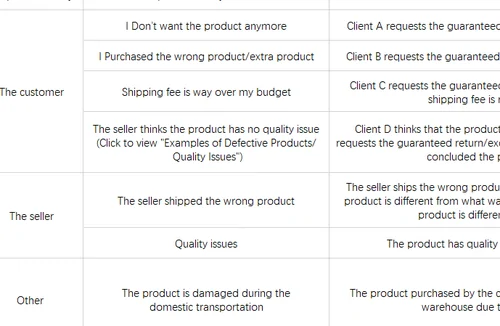
Return or exchange can be requested within 5 days, which the warehouse page counts down as 120 hours, from the moment the order status becomes Stocked in. The warehouse shows it as hours rather than days, which is a more honest display: five days sounds like a week and is not. The rule is help article 10041, read 2026-10-10.
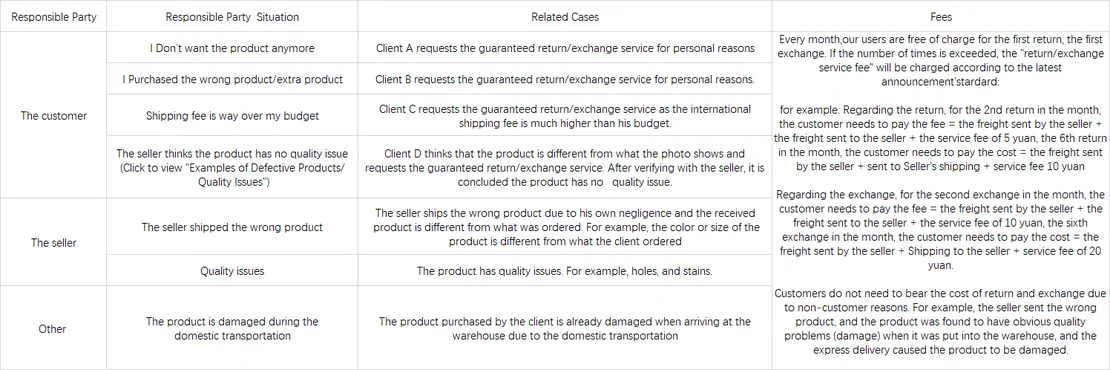
The buyer pays return shipping and a service fee taken from the account balance, and the refund base is the product price actually paid. There is no charge when the cause is the seller or damage in domestic transport.
Afterwards
After the window closes
The operator's rule splits on whether inspection photos exist. With QC images already provided, the seller may deny the request. Without QC images, a full refund applies. A seller's own 14-day guarantee, where one exists, is separate from the operator's window.
That split is the practical argument for opening the photos the day they arrive rather than the day before you ship.
Traps
Where buyers lose a window
Three recurring mistakes, all of them about timing rather than money. Treating the 120 hours as starting when the parcel ships, when it starts at stock-in. Letting the account balance sit empty, so a return fee cannot be taken and the request stalls. Buying from several shops weeks apart, so the storage counters drift out of step and the earliest item expires while you wait for the last.
A fourth is quieter. Paying late in the evening European time means nothing is purchased until the next working window, 09:00 to 18:00 UTC+8, which pushes every downstream clock by a day.

Taking a ready find to the agent
When all six fields are set, the next screen is the operator's. Registration asks for an email address, a username and a password.
Facts on this page last read 2026-10-11. Links to the agent carry a referral parameter; see how this site is paid.